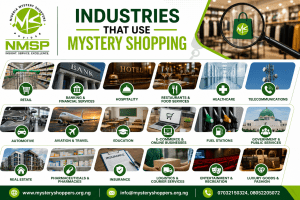
Industries That Use Mystery Shopping
Mystery shopping is widely used across industries to assess customer service, operational standards, employee performance, and overall customer experience. Below are some of the key industries that benefit from mystery shopping.
- Retail Industry
Retail businesses use mystery shoppers to evaluate:
- Customer service quality
- Product availability
- Store cleanliness
- Staff knowledge and professionalism
- Checkout efficiency
- Compliance with company standards
Examples: Supermarkets, clothing stores, electronics stores, pharmacies.
- Banking and Financial Services
Banks use mystery shopping to assess:
- Customer service
- Account opening procedures
- Loan application processes
- Staff professionalism
- Compliance with regulatory requirements
- Waiting times
Examples: Commercial banks, microfinance banks, insurance companies.
- Hospitality Industry
Hotels and resorts use mystery shopping to evaluate:
- Reception and check-in experience
- Room cleanliness
- Staff courtesy
- Food and beverage services
- Complaint handling
- Guest satisfaction
- Restaurants and Fast-Food Chains
Restaurants assess:
- Food quality
- Order accuracy
- Waiting time
- Hygiene standards
- Staff friendliness
- Dining experience
- Healthcare Industry
Hospitals and clinics use mystery shopping to evaluate:
- Patient reception
- Appointment scheduling
- Staff communication
- Facility cleanliness
- Professionalism
- Service efficiency
- Telecommunications
Telecom companies assess:
- Customer support
- SIM registration process
- Complaint resolution
- Product knowledge
- Service delivery
- Store experience
Examples: MTN, Airtel, Glo, 9mobile.
- Automotive Industry
Car dealerships and service centers evaluate:
- Sales consultations
- Vehicle demonstrations
- Service quality
- Customer follow-up
- Repair turnaround time
- Real Estate
Real estate firms use mystery shopping to assess:
- Property inspections
- Agent professionalism
- Response time
- Transparency in pricing
- Customer engagement
- Education Sector
Schools and training institutions evaluate:
- Admission processes
- Customer service
- Information provided to prospective students
- Campus facilities
- Administrative efficiency
- Aviation Industry
Airlines and airports assess:
- Ticketing services
- Check-in procedures
- Boarding experience
- Cabin crew service
- Baggage handling
- Customer satisfaction
- Fuel Stations
Petrol stations use mystery shopping to monitor:
- Fuel dispensing accuracy
- Customer service
- Cleanliness
- Staff honesty
- Safety compliance
- E-commerce and Online Businesses
Online retailers evaluate:
- Website usability
- Product availability
- Delivery speed
- Customer support
- Return and refund processes
- Payment experience
- Government and Public Services
Public institutions use mystery shopping to improve:
- Service delivery
- Staff responsiveness
- Transparency
- Waiting times
- Citizen satisfaction
- Healthcare and Pharmacy Chains
Pharmacies assess:
- Product availability
- Pharmacist knowledge
- Prescription handling
- Customer care
- Regulatory compliance
- Luxury Goods and Fashion
Luxury brands evaluate:
- Personalized customer service
- Product presentation
- Brand experience
- Staff etiquette
- Sales techniques
- Entertainment and Recreation
Entertainment venues assess:
- Ticket purchasing
- Customer service
- Cleanliness
- Security
- Visitor experience
Examples: Cinemas, amusement parks, event centers.
- Logistics and Courier Services
Courier companies use mystery shopping to evaluate:
- Parcel handling
- Delivery speed
- Customer communication
- Staff professionalism
- Complaint resolution
- Consumer Protection Organizations
Consumer protection agencies and advocacy groups use mystery shopping to:
- Detect unfair trade practices
- Monitor compliance with consumer protection laws
- Evaluate service standards
- Identify misleading advertising
- Support investigations and enforcement activities
Benefits Across These Industries
- Improves customer satisfaction
- Enhances service quality
- Identifies operational weaknesses
- Supports employee training
- Ensures compliance with company policies
- Strengthens brand reputation
- Increases customer loyalty
- Boosts business performance
- Provides objective and actionable feedback
Conclusion
Mystery shopping is a versatile quality assurance and customer experience tool used across many industries. Whether in retail, banking, healthcare, hospitality, telecommunications, or government services, it helps organizations measure real customer experiences, improve service delivery, and maintain high operational standards while building trust and loyalty among customers.