
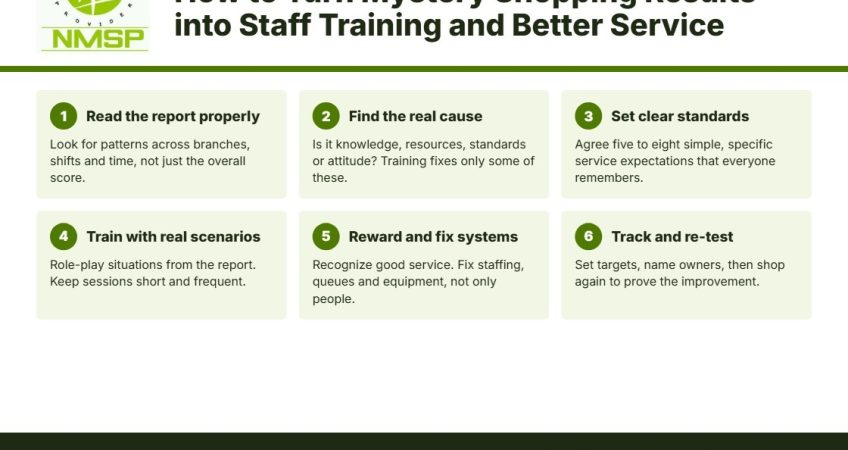
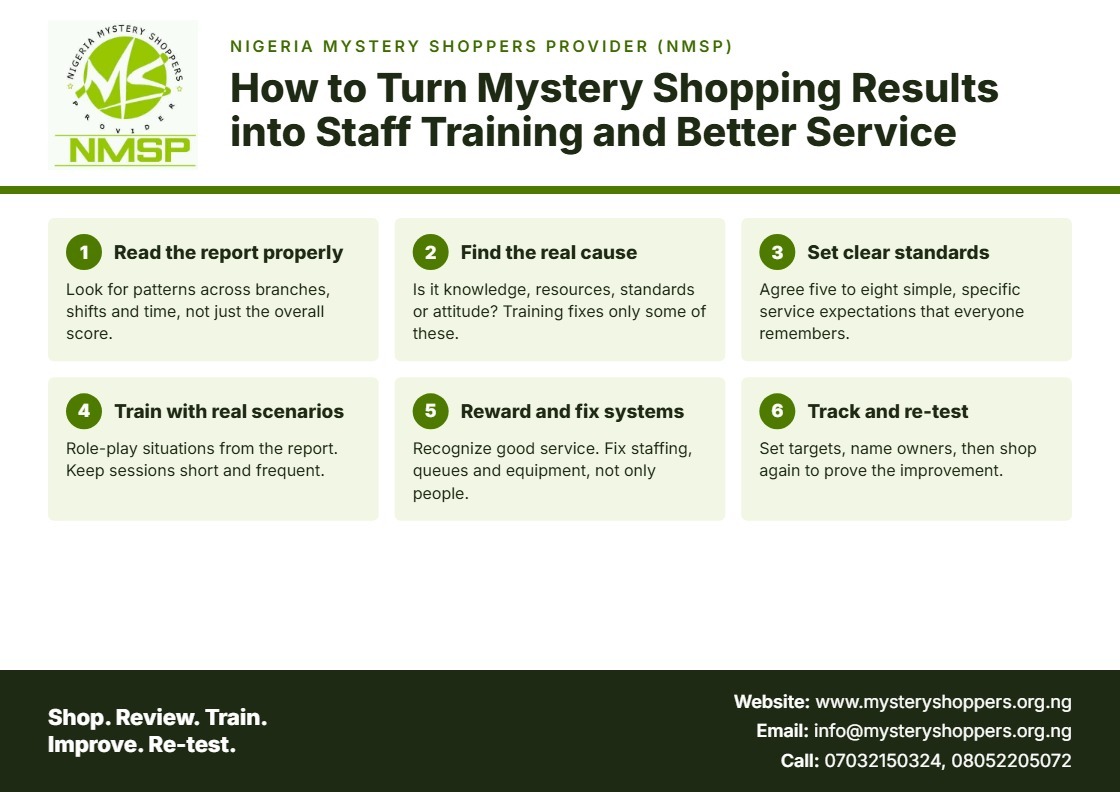
How to Turn Mystery Shopping Results into Staff Training and Better Service
A mystery shopping report can sit in a drawer and change nothing. Many businesses pay for the exercise, read the scores, feel pleased or embarrassed, and carry on as before. The value of mystery shopping lies in what happens after the report arrives.
This article explains how to turn findings into training, training into new habits, and new habits into service customers notice.
Step 1: Read the Report Properly
Do not stop at the overall score. A score of 72% tells you little. The details tell you what to fix.
- Look for patterns. One rude cashier is an incident. The same complaint across five branches is a problem with your system or training.
- Separate strengths from weaknesses. Note what staff did well so you can recognize and repeat it.
- Compare across locations, shifts and time. Weekend service may be weaker than weekday service. One branch may consistently outperform the others.
- Read the comments, not just the numbers. A shopper’s account of how a staff member spoke, or how long a customer waited, shows what a score cannot.
Step 2: Identify the Real Cause
A service failure is not always a staff attitude problem. Before planning training, ask why it happened.
- Did the staff member not know what to do (a knowledge gap)?
- Did they know but lack the tools or time (a resources gap)?
- Were they unsure what the business expects (a standards gap)?
- Did they know, have the means, and still not do it (an attitude or motivation gap)?
Training fixes knowledge and standards gaps. It does not fix understaffing, broken equipment or poor pay. If long queues come from having one teller on duty, no customer care course will help.
Step 3: Set Clear Service Standards
Staff cannot meet a standard they have never been told. Turn your findings into simple, specific expectations, such as:
- Greet every customer within 30 seconds of entry.
- Use the customer’s name where possible.
- Explain prices, charges and refund terms without being asked.
- Offer a clear next step when you cannot solve a problem immediately.
- Thank the customer and invite them back.
Keep the list short. Five to eight standards that everyone remembers beat thirty that no one can.
Step 4: Design Training Around What the Report Showed
Generic training wastes time. Build sessions around the weaknesses the report actually found.
- Role-play real scenarios. Use situations from the report, such as a customer asking for a refund or complaining about a delay. Let staff practice, then swap roles so they feel what the customer feels.
- Show good and bad examples. Walk through what the shopper observed, without naming individuals in front of colleagues.
- Teach product and policy knowledge. Many failures come from staff who cannot answer basic questions about prices, warranties or procedures.
- Train managers too. Supervisors must be able to coach, and must model the service they expect.
- Keep sessions short and frequent. A 30-minute weekly session works better than a full day once a year.
Step 5: Communicate Results Fairly
How you share the findings decides whether staff learn or become defensive.
- Share results with the whole team, not only managers.
- Start with what went well.
- Present problems as things the business needs to fix together, not as blame.
- Do not publicly shame individuals. Discuss personal performance privately.
- Explain that the goal is better service, not punishment.
Staff who feel ambushed will resent mystery shopping. Staff who understand its purpose will often welcome it.
Step 6: Recognize and Reward Good Service
People repeat what gets noticed. Recognition does not have to be expensive.
- Name the “Service Star” of the month.
- Share positive shopper comments with the person concerned.
- Link good results to bonuses, promotion or other rewards where possible.
- Let high performers coach their colleagues.
If only mistakes are ever mentioned, staff will learn to avoid risk rather than serve well.
Step 7: Fix the System, Not Only the People
Some problems belong to management. Use the report to examine:
- Staffing levels at peak hours
- Queue and waiting systems
- Complaint and refund procedures
- Signage, cleanliness and price displays
- Equipment such as POS machines and network connections
When customers meet the same failure again and again, the cause often lies in how the business is organized.
Step 8: Set Targets and Track Progress
Turn improvement into numbers and deadlines.
- Pick two or three priority areas, not twenty.
- Set a target for each, for example: raise greeting compliance from 60% to 90% in three months.
- Assign an owner for each target.
- Review progress in regular meetings.
Step 9: Re-Test
Improvement is only proven by a second visit. Schedule follow-up mystery shopping a few months later, using the same criteria so results can be compared. Look at:
- Which weaknesses have improved
- Which have not, and why
- Whether any new problems have appeared
Repeating the cycle of shop, review, train, improve, re-test is what builds lasting service quality.
Common Mistakes to Avoid
- Filing the report and doing nothing
- Punishing staff instead of coaching them
- Training on topics the report did not raise
- Ignoring system problems and blaming individuals
- Testing once and never checking again
- Keeping results secret from the people who deliver the service
Conclusion
Mystery shopping gives a business a rare gift: an honest picture of how customers are treated when no one is watching. But the report is only the starting point. Real change comes when a business reads the findings carefully, finds the true causes, sets clear standards, trains staff with real examples, rewards good service, fixes its own systems, and checks again.
Don
How to Turn Mystery Shopping Results into Staff Training and Better Service
A mystery shopping report can sit in a drawer and change nothing. Many businesses pay for the exercise, read the scores, feel pleased or embarrassed, and carry on as before. The value of mystery shopping lies in what happens after the report arrives.
This article explains how to turn findings into training, training into new habits, and new habits into service customers notice.
Step 1: Read the Report Properly
Do not stop at the overall score. A score of 72% tells you little. The details tell you what to fix.
- Look for patterns. One rude cashier is an incident. The same complaint across five branches is a problem with your system or training.
- Separate strengths from weaknesses. Note what staff did well so you can recognize and repeat it.
- Compare across locations, shifts and time. Weekend service may be weaker than weekday service. One branch may consistently outperform the others.
- Read the comments, not just the numbers. A shopper’s account of how a staff member spoke, or how long a customer waited, shows what a score cannot.
Step 2: Identify the Real Cause
A service failure is not always a staff attitude problem. Before planning training, ask why it happened.
- Did the staff member not know what to do (a knowledge gap)?
- Did they know but lack the tools or time (a resources gap)?
- Were they unsure what the business expects (a standards gap)?
- Did they know, have the means, and still not do it (an attitude or motivation gap)?
Training fixes knowledge and standards gaps. It does not fix understaffing, broken equipment or poor pay. If long queues come from having one teller on duty, no customer care course will help.
Step 3: Set Clear Service Standards
Staff cannot meet a standard they have never been told. Turn your findings into simple, specific expectations, such as:
- Greet every customer within 30 seconds of entry.
- Use the customer’s name where possible.
- Explain prices, charges and refund terms without being asked.
- Offer a clear next step when you cannot solve a problem immediately.
- Thank the customer and invite them back.
Keep the list short. Five to eight standards that everyone remembers beat thirty that no one can.
Step 4: Design Training Around What the Report Showed
Generic training wastes time. Build sessions around the weaknesses the report actually found.
- Role-play real scenarios. Use situations from the report, such as a customer asking for a refund or complaining about a delay. Let staff practice, then swap roles so they feel what the customer feels.
- Show good and bad examples. Walk through what the shopper observed, without naming individuals in front of colleagues.
- Teach product and policy knowledge. Many failures come from staff who cannot answer basic questions about prices, warranties or procedures.
- Train managers too. Supervisors must be able to coach, and must model the service they expect.
- Keep sessions short and frequent. A 30-minute weekly session works better than a full day once a year.
Step 5: Communicate Results Fairly
How you share the findings decides whether staff learn or become defensive.
- Share results with the whole team, not only managers.
- Start with what went well.
- Present problems as things the business needs to fix together, not as blame.
- Do not publicly shame individuals. Discuss personal performance privately.
- Explain that the goal is better service, not punishment.
Staff who feel ambushed will resent mystery shopping. Staff who understand its purpose will often welcome it.
Step 6: Recognize and Reward Good Service
People repeat what gets noticed. Recognition does not have to be expensive.
- Name the “Service Star” of the month.
- Share positive shopper comments with the person concerned.
- Link good results to bonuses, promotion or other rewards where possible.
- Let high performers coach their colleagues.
If only mistakes are ever mentioned, staff will learn to avoid risk rather than serve well.
Step 7: Fix the System, Not Only the People
Some problems belong to management. Use the report to examine:
- Staffing levels at peak hours
- Queue and waiting systems
- Complaint and refund procedures
- Signage, cleanliness and price displays
- Equipment such as POS machines and network connections
When customers meet the same failure again and again, the cause often lies in how the business is organized.
Step 8: Set Targets and Track Progress
Turn improvement into numbers and deadlines.
- Pick two or three priority areas, not twenty.
- Set a target for each, for example: raise greeting compliance from 60% to 90% in three months.
- Assign an owner for each target.
- Review progress in regular meetings.
Step 9: Re-Test
Improvement is only proven by a second visit. Schedule follow-up mystery shopping a few months later, using the same criteria so results can be compared. Look at:
- Which weaknesses have improved
- Which have not, and why
- Whether any new problems have appeared
Repeating the cycle of shop, review, train, improve, re-test is what builds lasting service quality.
Common Mistakes to Avoid
- Filing the report and doing nothing
- Punishing staff instead of coaching them
- Training on topics the report did not raise
- Ignoring system problems and blaming individuals
- Testing once and never checking again
- Keeping results secret from the people who deliver the service
Conclusion
Mystery shopping gives a business a rare gift: an honest picture of how customers are treated when no one is watching. But the report is only the starting point. Real change comes when a business reads the findings carefully, finds the true causes, sets clear standards, trains staff with real examples, rewards good service, fixes its own systems, and checks again.
Done well, mystery shopping does more than raise scores. It builds staff who take pride in their work and customers who feel respected and want to return. Every business that serves the public can offer that, and every consumer deserves it.