
Introduction
In today’s highly regulated, customer driven, and digitally exposed business environment, risk management extends far beyond finance and operations. For large corporations operating in Nigeria, customer experience failures have become a major source of reputational, regulatory, and revenue risk.
Mystery shopping has emerged as a powerful, underutilized risk management tool—one that allows organizations to see their business through the eyes of real customers, identify hidden vulnerabilities, and prevent small service lapses from escalating into major corporate crises. Professional providers such as Nigeria Mystery Shoppers (www.mysteryshoppers.org.ng) deliver these insights with local expertise and industry precision.
Understanding Risk Beyond the Boardroom
Corporate risk is no longer limited to balance sheets, compliance audits, or internal controls. Frontline interactions—how staff treat customers, handle complaints, follow procedures, and represent the brand—now carry significant risk exposure.
A single unresolved customer issue can quickly move from a store counter to social media, regulators, or the courts. Mystery shopping helps large corporations detect these risks early, long before they appear in dashboards, reports, or public headlines.
How Mystery Shopping Identifies Hidden Operational Risks
Traditional internal audits often focus on policies, documentation, and reported performance. Mystery shopping, by contrast, reveals what actually happens on the ground.
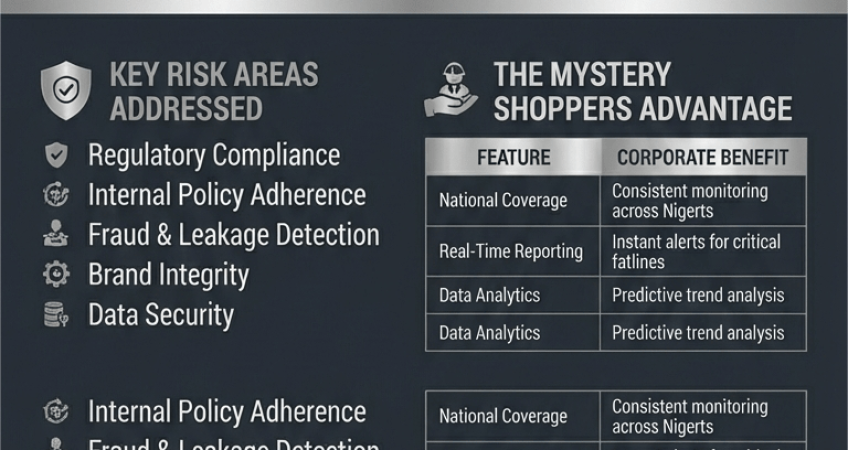
Through structured, real-world assessments, mystery shoppers uncover:
- Non compliance with service standards and regulations
- Inconsistent pricing, disclosures, or promotional execution
- Weak complaint handling and escalation processes
- Poor staff knowledge of products, policies, or consumer rights
- Service gaps across branches, regions, or channels
Individually, these issues may seem minor. Collectively, they represent significant operational and reputational risk for large corporations.
Regulatory and Consumer Protection Risks in Nigeria
Nigeria’s regulatory environment has become increasingly assertive. Agencies such as the FCCPC, CBN, NCC, NAFDAC, and other sector specific regulators closely monitor consumer complaints and service failures.
Mystery shopping provides corporations with independent evidence of how consumer protection obligations are being met across touchpoints. This enables leadership to proactively address compliance gaps, reduce exposure to sanctions, and demonstrate good faith commitment to consumer protection.
Reputational Risk in the Age of Social Media
For large brands, reputation is both valuable and fragile. Negative customer experiences now spread rapidly through reviews, screenshots, videos, and online advocacy platforms.
Mystery shopping helps corporations identify reputational risks before customers make them public. Early intervention protects brand equity, maintains trust, and avoids costly damage control.
Enterprise Wide Visibility Across Large Networks
Large corporations face complex challenges: multiple branches, outsourced staff, franchise models, high turnover, and regional inconsistencies. Senior management often lacks an unbiased view of frontline reality.
Mystery shopping delivers standardized, comparable insights across locations—allowing executives to detect systemic risks, benchmark performance, and make data driven risk mitigation decisions.
Turning Insight into Risk Mitigation
The true value of mystery shopping lies in action. When integrated into corporate risk frameworks, it supports targeted training, policy refinement, performance management, and continuous monitoring of risk exposure.
Rather than reacting to crises, organizations gain the ability to manage risk proactively and systematically.
Why Local Expertise Matters in Nigeria
Effective risk based mystery shopping requires deep local understanding. Nigeria’s regulatory expectations, cultural nuances, and consumer behavior demand context aware assessment models.
A professional Nigeria based provider like Nigeria Mystery Shoppers (www.mysteryshoppers.org.ng) delivers practical, credible, and actionable insights tailored to local realities and sector specific risks.
Conclusion
In an era where customer experience, regulation, and reputation are tightly connected, mystery shopping has evolved into a strategic risk management instrument for large corporations. It exposes blind spots, strengthens compliance, protects brand reputation, and supports informed executive decision making.
For Nigerian corporations seeking resilience, trust, and sustainable growth, investing in professional mystery shopping programmes through www.mysteryshoppers.org.ng is no longer optional—it is a critical component of modern risk governance.