
Measuring Service Quality Through Mystery Shopping
Introduction
In today’s competitive marketplace, service quality is a key factor that influences customer satisfaction, trust, and business success. Consumers expect to receive courteous treatment, accurate information, fair pricing, and timely service whenever they purchase goods or services. Unfortunately, these expectations are not always met. One of the most effective ways of evaluating service quality is through mystery shopping.
Mystery shopping provides businesses, regulators, and consumer advocacy organizations with an objective way to assess how customers are treated and whether organizations consistently meet acceptable service standards. It helps identify strengths, reveal service gaps, and promote continuous improvement.
What is Mystery Shopping?
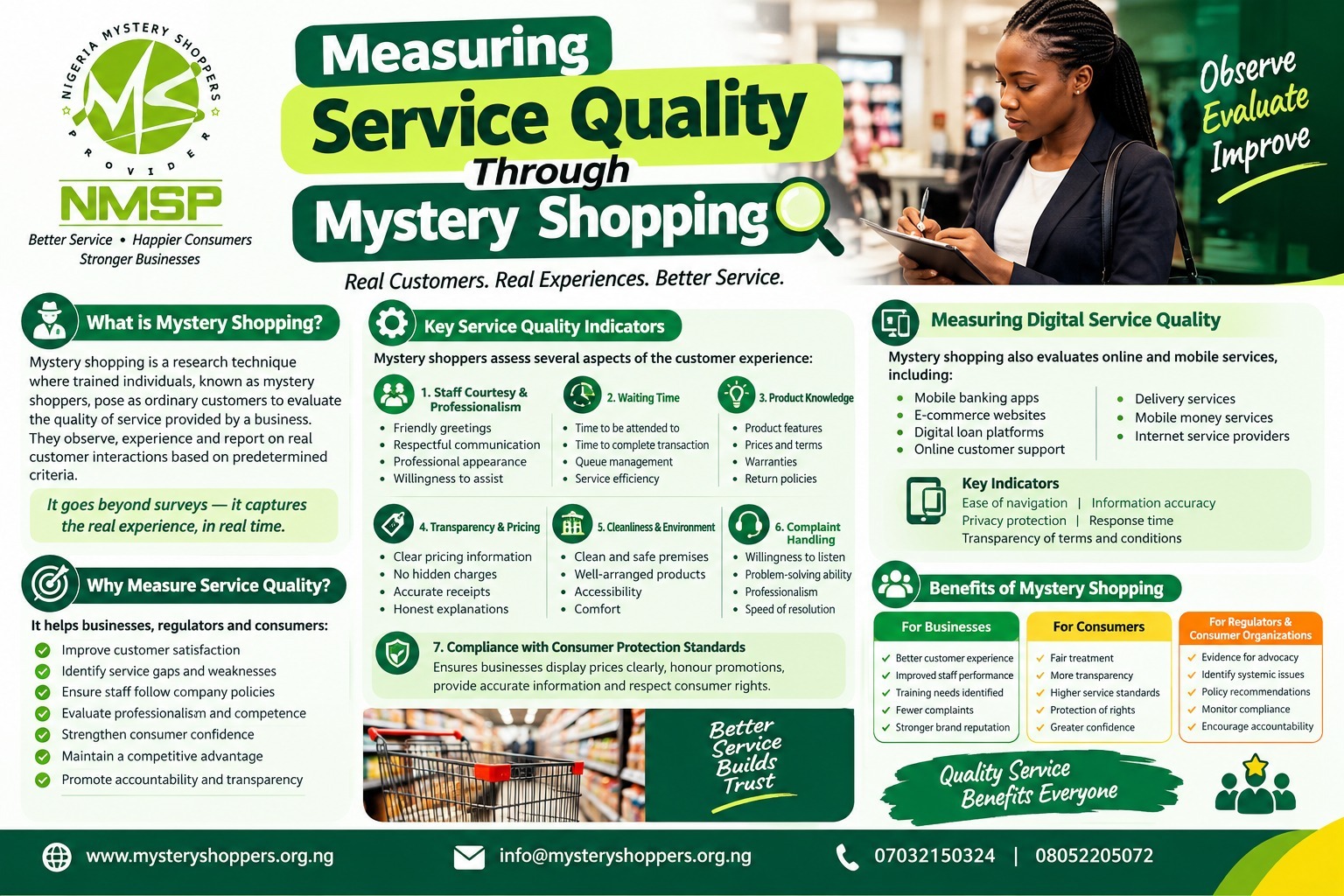
Mystery shopping is a research technique in which trained individuals, known as mystery shoppers, pose as ordinary customers to evaluate the quality of service provided by a business. During their visit, they observe and document specific aspects of the customer experience based on predetermined evaluation criteria.
Unlike customer satisfaction surveys, which rely on opinions after a purchase, mystery shopping captures real-time observations of actual service delivery.
Why Measure Service Quality?
Measuring service quality helps organizations to:
- Improve customer satisfaction.
- Identify weaknesses in service delivery.
- Ensure employees comply with company policies.
- Evaluate staff professionalism and competence.
- Strengthen consumer confidence.
- Maintain competitive advantage.
- Promote accountability and transparency.
For consumer advocacy organizations, mystery shopping provides evidence that can be used to educate consumers, engage businesses, and advocate for improved service standards.
Key Service Quality Indicators
A mystery shopper evaluates several aspects of the customer experience, including:
- Staff Courtesy and Professionalism
Customers should be welcomed respectfully and treated with courtesy throughout their interaction.
Indicators include:
- Friendly greetings
- Respectful communication
- Professional appearance
- Positive attitude
- Willingness to assist
- Waiting Time
Consumers value prompt service.
Mystery shoppers assess:
- Time before being attended to
- Time taken to complete transactions
- Efficiency of service
- Queue management
- Product Knowledge
Employees should provide accurate information about products and services.
The shopper evaluates whether staff can explain:
- Product features
- Prices
- Terms and conditions
- Warranties
- Return policies
- Transparency and Pricing
Businesses should provide clear and accurate pricing information.
Mystery shoppers look for:
- Hidden charges
- Price discrepancies
- Accurate receipts
- Clear billing
- Honest explanations of fees
- Cleanliness and Environment
The physical environment reflects a company’s commitment to quality.
Areas assessed include:
- Cleanliness
- Safety
- Product arrangement
- Accessibility
- Comfort
A quality business responds effectively to customer complaints.
Mystery shoppers evaluate:
- Staff willingness to listen
- Problem-solving ability
- Professionalism
- Speed of resolution
- Escalation procedures
- Compliance with Consumer Protection Standards
Mystery shopping helps determine whether businesses comply with consumer protection laws and ethical business practices.
This includes checking whether businesses:
- Display prices clearly.
- Honour advertised promotions.
- Provide accurate product information.
- Respect consumer rights.
- Avoid misleading claims.
Measuring Digital Service Quality
As more services move online, mystery shopping is increasingly used to evaluate digital customer experiences.
Digital assessments may include:
- Mobile banking applications
- Digital loan platforms
- E-commerce websites
- Online customer support
- Delivery services
Key indicators include:
- Ease of navigation
- Information accuracy
- Privacy protection
- Speed of response
- Transparency of terms and conditions
Benefits of Mystery Shopping
For Businesses
- Improves customer experience.
- Enhances employee performance.
- Identifies training needs.
- Reduces customer complaints.
- Builds brand reputation.
For Consumers
- Encourages fair treatment.
- Promotes transparency.
- Improves service standards.
- Protects consumer rights.
- Builds trust in the marketplace.
For Regulators and Consumer Organizations
- Provides evidence for advocacy.
- Identifies systemic issues.
- Supports policy recommendations.
- Monitors compliance with regulations.
- Encourages accountability.
Challenges of Mystery Shopping
Although highly effective, mystery shopping has some limitations:
- It reflects performance at a specific point in time.
- Employees may behave differently if they suspect they are being evaluated.
- Results depend on well-trained mystery shoppers.
- Poorly designed evaluation criteria may produce unreliable findings.
To overcome these challenges, organizations should use standardized checklists, train mystery shoppers thoroughly, and conduct assessments regularly.
Best Practices for Effective Mystery Shopping
To obtain reliable results:
- Define clear objectives.
- Develop standardized evaluation forms.
- Train mystery shoppers on observation and reporting.
- Ensure confidentiality.
- Conduct visits at different times and locations.
- Use factual, evidence-based reporting.
- Analyse results to identify trends.
- Share findings constructively with businesses.
Conclusion
Mystery shopping is a powerful tool for measuring service quality and strengthening consumer protection. By providing an objective assessment of real customer experiences, it helps businesses improve their services, supports regulators in monitoring compliance, and empowers consumer organizations to advocate for higher standards. Organizations that embrace mystery shopping demonstrate a commitment to transparency, accountability, and customer satisfaction, while consumers benefit from fairer treatment, better information, and greater confidence in the marketplace.
“Quality service begins with understanding the customer’s experience—and mystery shopping makes that experience visible.”