
Introduction
Customer experience is one of the most discussed yet least verified aspects of modern business. While big brands project confidence through polished messaging and structured service systems, small and medium sized enterprises (SMEs) often rely on personal relationships and proximity to customers. Mystery shopping provides a rare opportunity to move beyond assumptions and examine how these two worlds perform when faced with real customer interactions. This comparison reveals insights that challenge conventional beliefs and offer valuable lessons for organisations of every size.
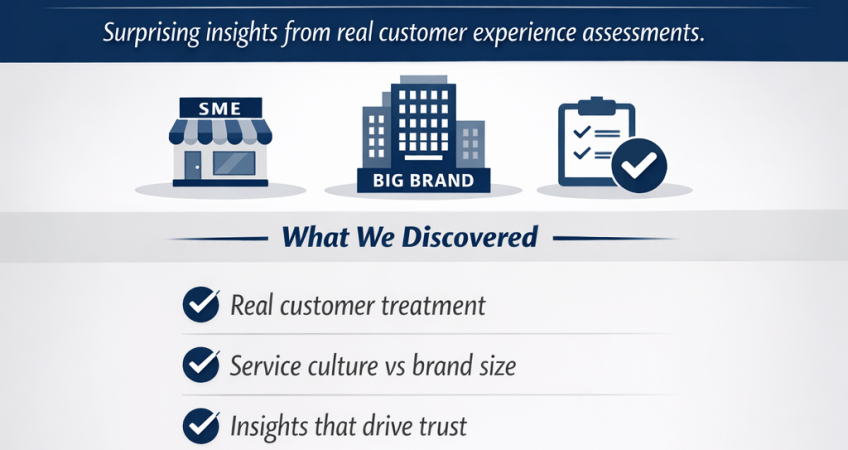
Customer experience is often discussed in broad terms, yet rarely tested where it truly matters at the point of real interaction. Mystery shopping offers a quiet but powerful lens into how organisations actually treat customers, beyond polished advertisements and brand promises. When small and medium sized enterprises (SMEs) are compared with big brands, the results are often unexpected.
Large brands typically invest heavily in customer service structures, scripted responses, and digital touchpoints. From call centres to automated chat systems, processes are designed for scale and consistency. While this can create efficiency, it can also introduce distance. In many cases, customers encounter rigid procedures, delayed responses, or frontline staff with limited authority to resolve issues quickly.
SMEs, on the other hand, operate closer to their customers. Mystery shopping frequently reveals a more personal tone direct engagement, flexibility, and faster decision making. Customers are often recognised, listened to, and assisted with a sense of ownership. However, this advantage is not without gaps. Service quality can vary widely, and professionalism may depend heavily on the individual rather than a standard.
What becomes clear through repeated mystery shopping exercises is that size alone does not determine service quality. Some big brands outperform expectations by empowering staff and simplifying processes, while some SMEs lose trust through inconsistency or informality. The difference lies not in resources, but in culture how seriously customer experience is treated at every level.
For businesses, these insights are instructive. Big brands can learn from the warmth and accountability often found in smaller businesses, while SMEs can adopt simple service standards that protect quality as they grow. For customers, the findings challenge assumptions about where respect, responsiveness, and value are most likely to be found.
Mystery shopping does not aim to shame or praise blindly. It provides evidence quiet, honest, and difficult to ignore. And as these comparisons show, the organisations that win customer loyalty are not always the biggest, but the most intentional about how people are treated when no one is watching.
Conclusion
The findings from mystery shopping exercises suggest that exceptional customer treatment is not defined by size, visibility, or market dominance. Instead, it is shaped by intention, accountability, and everyday behaviour. While big brands benefit from structure and scale, SMEs often excel through responsiveness and personal connection. The organisations that stand out are those that combine consistency with genuine care. For businesses seeking trust, loyalty, and long term relevance, the message is clear: customers remember how they are treated when no one is performing for the spotlight.